Lebanese government tasks army with enforcing state monopoly on weapons in Beirut
Wassim Samih Seifeddine
09 April 2026•Update: 09 April 2026
Lebanon’s Cabinet on Thursday instructed the army to immediately begin enforcing state control over weapons in the capital Beirut and limit arms possession to official security forces.
The Cabinet also decided to file an urgent complaint with the UN Security Council over Israeli attacks on the country.
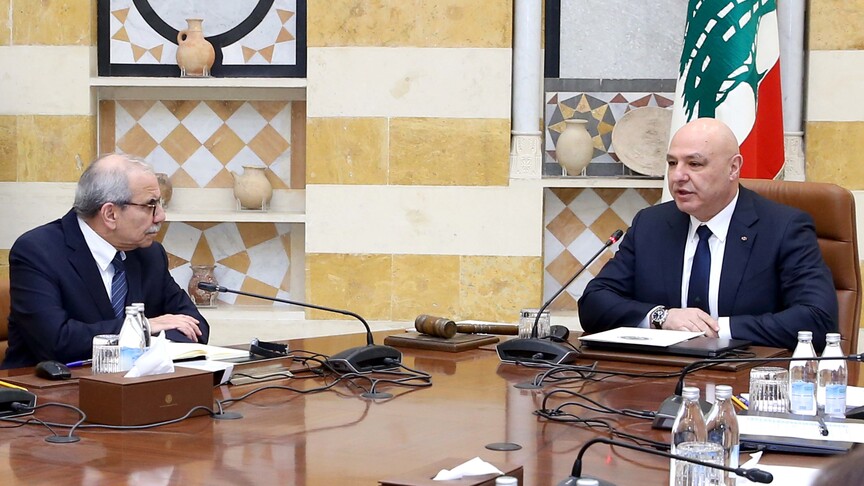
The session took place at the presidential palace in Baabda, east of Beirut, under the chairmanship of President Joseph Aoun and in the presence of Prime Minister Nawaf Salam, Information Minister Paul Morcos said at a press conference.
During the session, Salam stated that the decision was made “to preserve the safety, security, and property of citizens.”
Salam “instructed the army and security forces to immediately begin reinforcing the state’s full control over the Beirut governorate and bring all weapons under the legitimate security forces only.”
On Jan. 8, the Lebanese army said its plan to restrict weapons had “achieved the objectives of its first phase south of the Litani River in southern Lebanon and entered an advanced stage.” It warned, however, that Israeli attacks and the occupation of Lebanese territory were hindering progress of the plan.
Hezbollah has repeatedly said it will not surrender its weapons while the Israeli occupation continues.
Salam added that the government “decided to file an urgent complaint with the UN Security Council against Israel, in light of its attacks on Lebanon.”
At the start of the session, Aoun said Lebanon “is tired of mere statements of condemnation,” expressing regret that the country was not included in the ceasefire announced between the United States and Iran, despite expectations in that direction.
Israeli airstrikes struck wide areas of Beirut on Wednesday, hitting residential neighborhoods with a Sunni majority and raising fears of high civilian casualties.
The escalation followed the announcement by the US and Iran of a two-week ceasefire on Tuesday, brokered by Pakistan, as a step toward a possible broader agreement to halt a conflict launched by Washington and Tel Aviv against Tehran on Feb. 28 that has left thousands killed and wounded.
While Islamabad and Tehran said the ceasefire included Lebanon, Washington and Tel Aviv denied that, and the Israeli military launched a wave of airstrikes on Wednesday that killed 254 people and wounded 1,165 others, according to Lebanon’s Civil Defense.
The expanded Israeli offensive on Lebanon since March 2 has killed 1,739 people and wounded 5,873 others, according to the Lebanese Health Ministry
* Writing by Rasa Evrensel in Istanbul